SaaS Billing Payment Gateways: Five Options Beyond Stripe

Most starters wire Stripe and stop. That works until you sell into a market where cards are not the default, or you realise that calculating VAT as a sole founder is a second job. Choosing among SaaS billing payment gateways is less about features than about who carries the tax and compliance burden. This guide compares five providers and shows how to test the whole matrix without opening five sandbox accounts.
Processor or Merchant of Record?
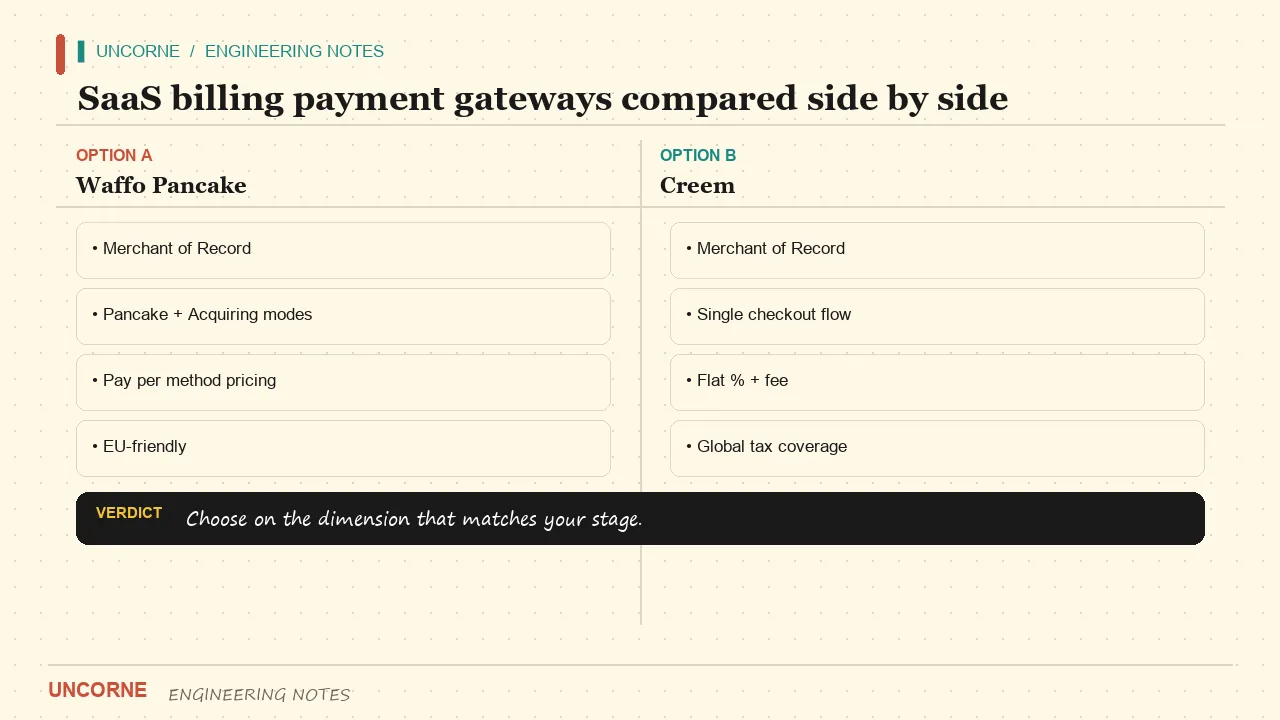
The single most important distinction is legal, not technical. A payment processor moves money; you remain the seller of record. A Merchant of Record becomes the legal seller: it calculates and remits sales tax and VAT, issues invoices, and often handles refunds and chargebacks.
| | Payment processor | Merchant of Record | | --- | --- | --- | | Examples | Stripe, PayPal, Waffo Acquiring | Waffo Pancake, Lemon Squeezy, Creem | | Who owns tax | You | The MoR | | Invoicing | Your code | The MoR | | Refunds and chargebacks | Your workflow | Usually handled by the MoR | | Best for | Teams with an entity and a tax stack | Solo founders selling globally |
For a solo founder without a company entity, that table is the whole decision. You are not buying a checkout; you are buying the removal of a compliance job.
The five providers, side by side
Uncorne ships five adapters behind one interface — Waffo Pancake, Waffo Acquiring, Stripe, Creem and Lemon Squeezy — plus none for bring-your-own billing. Selecting one in the Builder prunes the others from the downloaded ZIP, so you do not ship dead provider code.
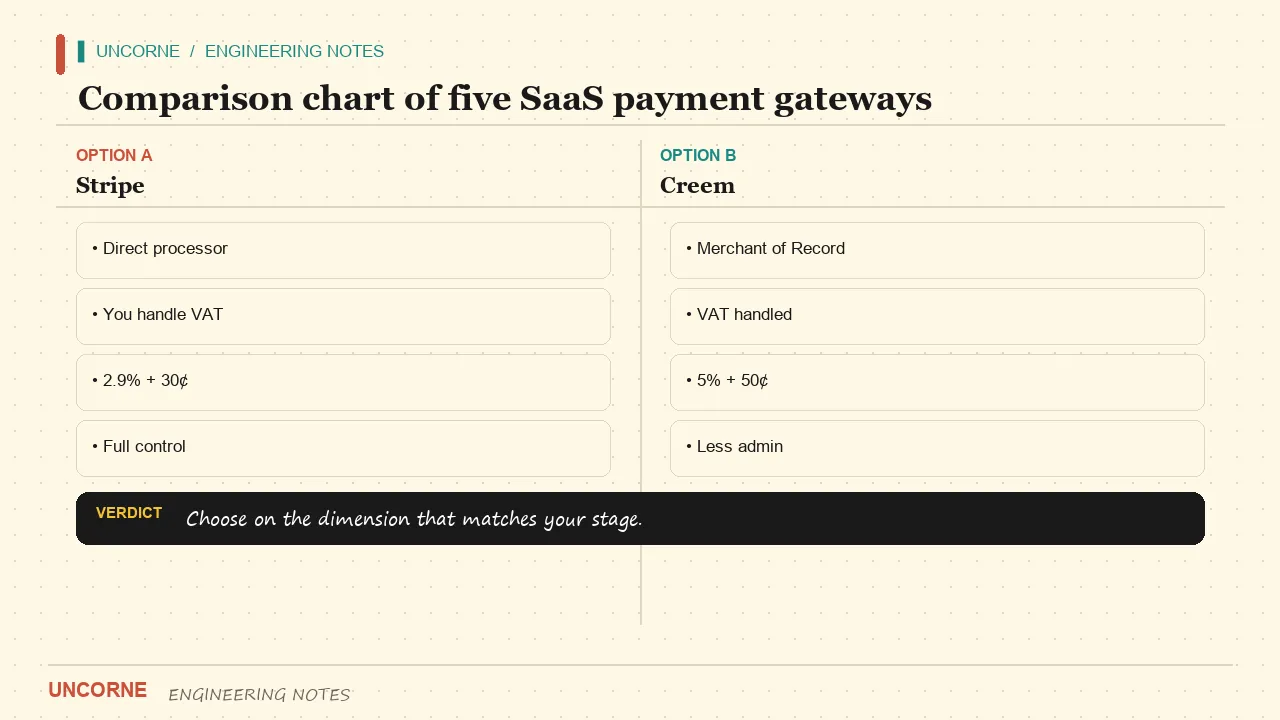
| Gateway | Model | Checkout | Webhook signing | Good fit | | --- | --- | --- | --- | --- | | Waffo Pancake | MoR, global | Hosted session | HMAC | Global SaaS, no entity | | Waffo Acquiring | SE-Asia acquiring | Hosted session | RSA | Regional acquiring contract | | Stripe | Processor | Checkout Sessions | HMAC | Teams with a tax setup | | Creem | MoR-style | Hosted checkout | HMAC | Digital products, Stripe-like API | | Lemon Squeezy | MoR | Hosted checkout | HMAC | Software, simple global sales |
Contract fields come from your agreement, not the code
This small detail separates a trustworthy integration from a dangerous one. Merchant ids, product or price ids, return and notify URLs, and signing modes must come from environment variables copied from your merchant agreement. The code never invents a plausible-looking placeholder. If a required variable is missing, the config layer throws an error that names that variable.
That rule matters most for Waffo Acquiring, whose WAFFO_ACQUIRING_* variables mirror fields in a signed contract. A fake default would fail at the worst possible time — on a live payment — and would be hard to debug. Explicit failure at boot is far kinder.
One verification contract, five implementations
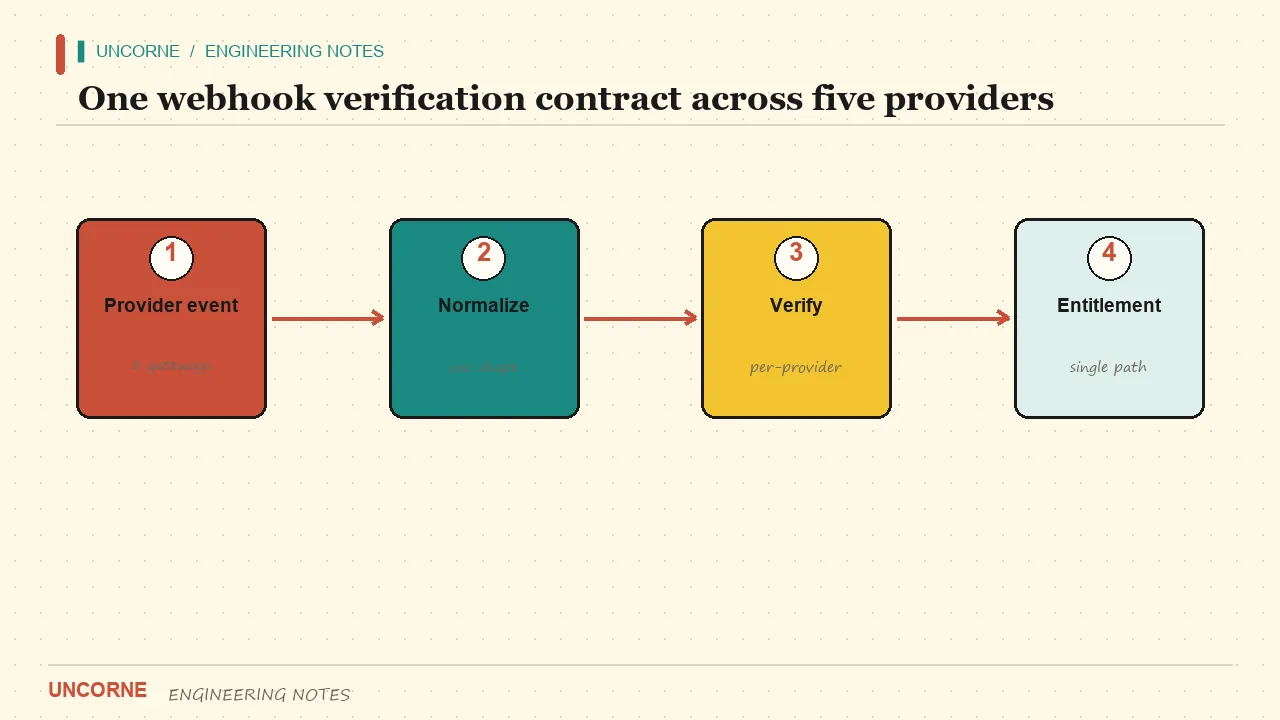
Every adapter follows the same three rules:
- Missing, invalid or malformed signature → throw; the route answers
400. - Validly signed but unhandled event → empty list; the route answers
200with an ignored flag. - Already-seen event id → skip before writing a plan or a license.
An earlier revision returned an empty list on verification failure, which meant a forged request was acknowledged with 200 across five gateways. A single wrong branch made every integration look successful to an attacker. That contract is now covered by an offline probe. For background, Stripe's signature verification guide explains the general principle, and our webhook contract article goes deeper on idempotency and plan gating.
How to test without five provider sandboxes
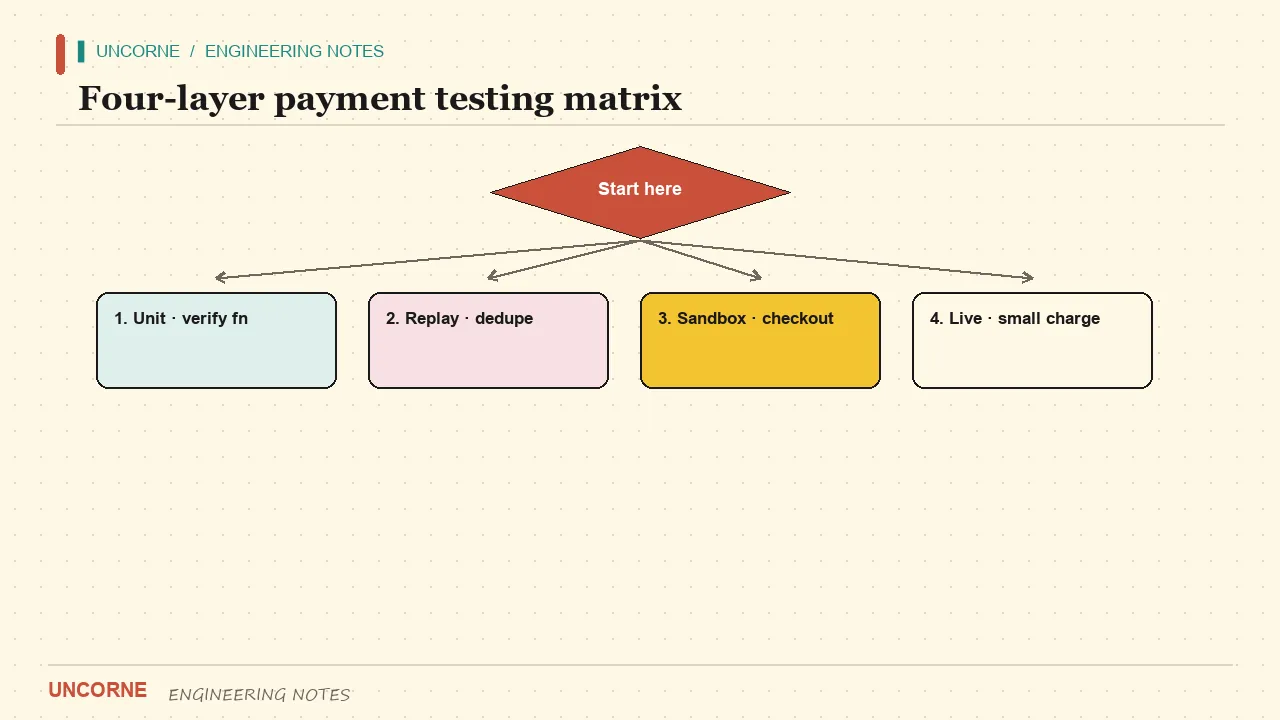
Four layers, in increasing order of cost:
- Config self-check — reports missing variable names only, never secret values. Runs with no credentials and is safe in CI logs.
- Offline signature probe —
npm run probe:webhooksends valid, missing, corrupted and malformed bodies to a running server and asserts400or200. No credentials needed. - Per-gateway sandbox runs — a real checkout in each provider's test mode. Needs each provider's sandbox keys.
- One real small-value purchase — before launch, on the provider you actually shipped, to confirm payout and settlement.
The first two catch the security invariant; the last two catch integration drift. The full environment-variable matrix lives in docs/payment-testing.md. You can also read our Waffo vs Creem comparison for the two most commonly paired options.
Where each gateway actually wins
The comparison table gives the shape; the details decide the fit. Stripe remains the strongest option when you already have a company entity, a tax advisor and a need for a deep API: its billing primitives cover metered usage, invoices and a large integration ecosystem. The trade-off is that tax calculation and compliance remain yours, and a processor account is not always available to a founder without an entity.
PayPal is rarely the first choice for a subscription SaaS, but it earns its place where buyers expect it — certain regions and older demographics convert noticeably better when a PayPal button is present. Treat it as an additional method rather than the primary system of record.
Waffo Pancake and Lemon Squeezy both remove the tax job. Choose between them on payout terms, dashboard quality and the countries you sell into, not on a feature checklist neither can honestly guarantee for your category. Creem sits close to the MoR model with a Stripe-like developer surface, which shortens integration time for a small team and suits digital products.
Waffo Acquiring is the outlier: a regional acquiring gateway for Southeast Asia with RSA-signed requests. It matters if you have a local acquiring contract or local payment methods your customers expect. If you do not, its extra configuration is cost without benefit.
None of these choices is permanent. Optimise for the ability to replace the adapter without changing product code — which is why the shared verification contract matters more than any single comparison.
A checklist before you commit
Write down five things first: your selling entity, the countries and currencies you need, your buyers' preferred payment methods, who owns tax, and your monthly volume. Score each provider against those five answers and re-check the result every six months. A gateway decision is a snapshot; the answers behind it are what change.
Honest limits
Comparing gateways on paper has a ceiling. Fee percentages move, onboarding review times change, and a provider that suits a US SaaS may be awkward in Southeast Asia. Treat any comparison — including this one — as a map, then verify on each provider's own documentation before you commit. Put a date on the snapshot you read.
The thing that stays constant is the architecture: one checkout contract, one webhook contract, and the gateway behind configuration. That is what makes the choice reversible, which matters more than any single fee table.
About the author: WangNan writes about shipping source-available SaaS at https://www.uncorne.com.
FAQ
What is the difference between a payment processor and a Merchant of Record?+
A processor such as Stripe or PayPal moves money but leaves tax calculation, invoicing and compliance with you. A Merchant of Record such as Waffo Pancake or Lemon Squeezy is the legal seller and handles VAT or sales tax, invoices and usually refunds.
Which gateways does this SaaS starter support?+
Waffo Pancake (default Merchant of Record), Waffo Acquiring, Stripe, Creem, Lemon Squeezy and none for bring-your-own billing. Only the selected adapter is included in the generated ZIP.
How can I test gateways without five sandbox accounts?+
Run the config self-check and the offline signature probe (npm run probe:webhook) first — neither needs credentials and both belong in CI. Then do per-gateway sandbox runs and one real small-value purchase before launch.
Will the code fill in missing merchant contract fields?+
No. Merchant ids, price ids, notify URLs and signing modes must come from environment variables copied from your agreement. A missing required variable raises an error naming it rather than supplying a fake default.
All frequently asked questions · Markdown version (for AI agents)