Waffo vs Creem: Which SaaS Payment Gateway to Pick in 2026

Choosing a payment gateway is one of the few decisions that is hard to reverse later: once customers, invoices and tax filings are tied to a provider, switching is painful. This comparison looks at two merchant-of-record-style options that indie founders keep comparing — Waffo and Creem — and strips away the marketing spin so you can decide from facts.
The short answer
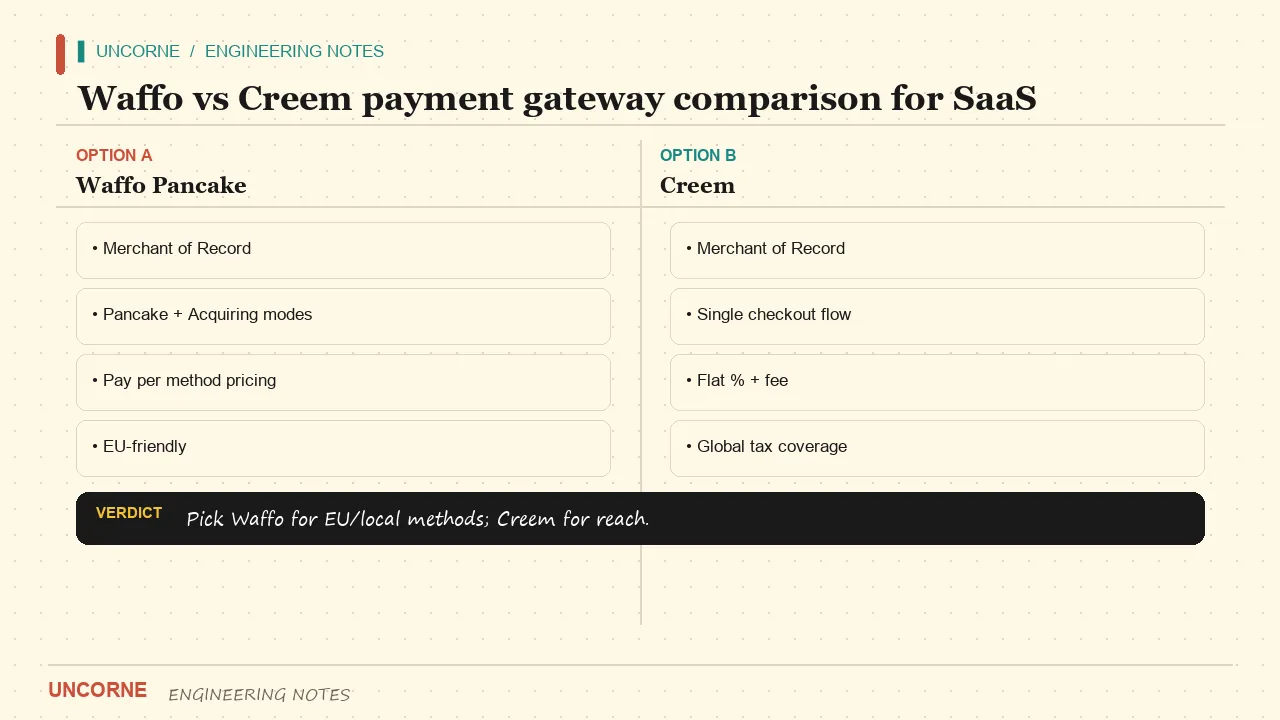
If you want the fastest Stripe-like integration with a hosted dashboard, start with Creem. If you want a Merchant of Record with a simple global checkout and no company entity, look at Waffo Pancake. If you already hold a regional acquiring contract in Southeast Asia, Waffo Acquiring is the only version of Waffo that makes sense. And if you are not sure yet, build behind a switchable layer so the gateway becomes a config change rather than a rewrite. The rest of this article explains why.
Two different product shapes
The first thing to understand is that "Waffo" is not a single product. In the Uncorne adapters it ships in two flavours:
- Pancake — a Merchant of Record and global checkout, documented at docs.waffo.ai. It takes on tax and positions itself as drop-in global selling.
- Acquiring — a Southeast Asian acquiring gateway, documented at waffo.com/docs, using RSA-signed requests and webhooks. It is built around a specific regional acquiring flow, not generic global checkout.
Creem is a hosted checkout plus a Merchant of Record, with a Stripe-like API and webhooks (docs.creem.io). The practical difference: Creem and Waffo Pancake are close to "drop-in global checkout", while Waffo Acquiring serves a narrower regional role. Comparing them as if they were the same category leads to the wrong conclusion.
Side-by-side comparison
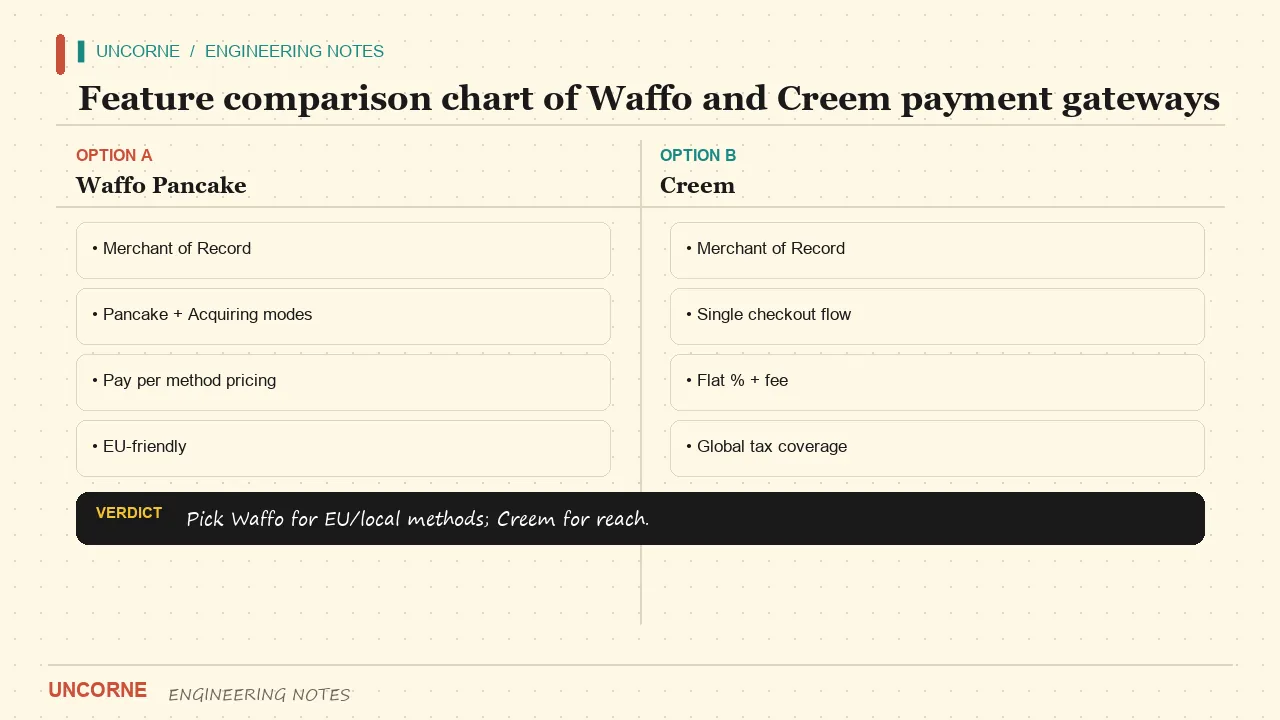
| Dimension | Waffo Pancake | Waffo Acquiring | Creem | | --- | --- | --- | --- | | Model | Merchant of Record | Regional acquiring | Merchant of Record | | Checkout | Hosted session | Hosted session | Hosted checkout | | API style | Store slug or API key | RSA-signed requests | Stripe-like REST | | Webhook signing | HMAC-style | RSA, platform public key | HMAC-style | | Tax and VAT | Handled by MoR | Merchant's responsibility | Handled by MoR | | Best for | Global SaaS, no entity | SE-Asia acquiring contract | Digital goods, fast integration | | Key docs | docs.waffo.ai | waffo.com/docs | docs.creem.io |
Fees and payouts: read beyond the headline percentage
Both providers are merchant-of-record style, which means they take a higher cut than a raw processor because they absorb sales tax, VAT and compliance work. That is not a hidden surcharge — it is the product. Exact numbers move constantly, so verify on each provider's pricing page before you commit; a comparison snapshot has a shelf life of weeks, not years.
What matters more than the headline percentage is the payout schedule, the settlement currency, and whether refunds and chargebacks are netted transparently. A gateway charging half a point more but paying out weekly with clear statements is often cheaper in practice than one that is slightly cheaper on paper and opaque at reconciliation. Ask three concrete questions before you sign: when do funds land, in which currency, and how is a refund deducted from the next payout?
Onboarding and KYC
Creem's onboarding is aimed at digital products and is generally quick for software. Waffo Pancake onboarding is straightforward for a solo founder. Waffo Acquiring is heavier because it requires the merchant contract fields — merchant info, user info, payment info, currency and order description — that our integration reads from environment variables.
Neither is instant if your product category triggers extra review. Graphics, adult content, crypto-adjacent tools and certain AI use cases can add manual checks at any provider. Budget a week or two of slack rather than assuming same-day approval, and do not wire your launch date to an onboarding promise.
Global coverage and tax
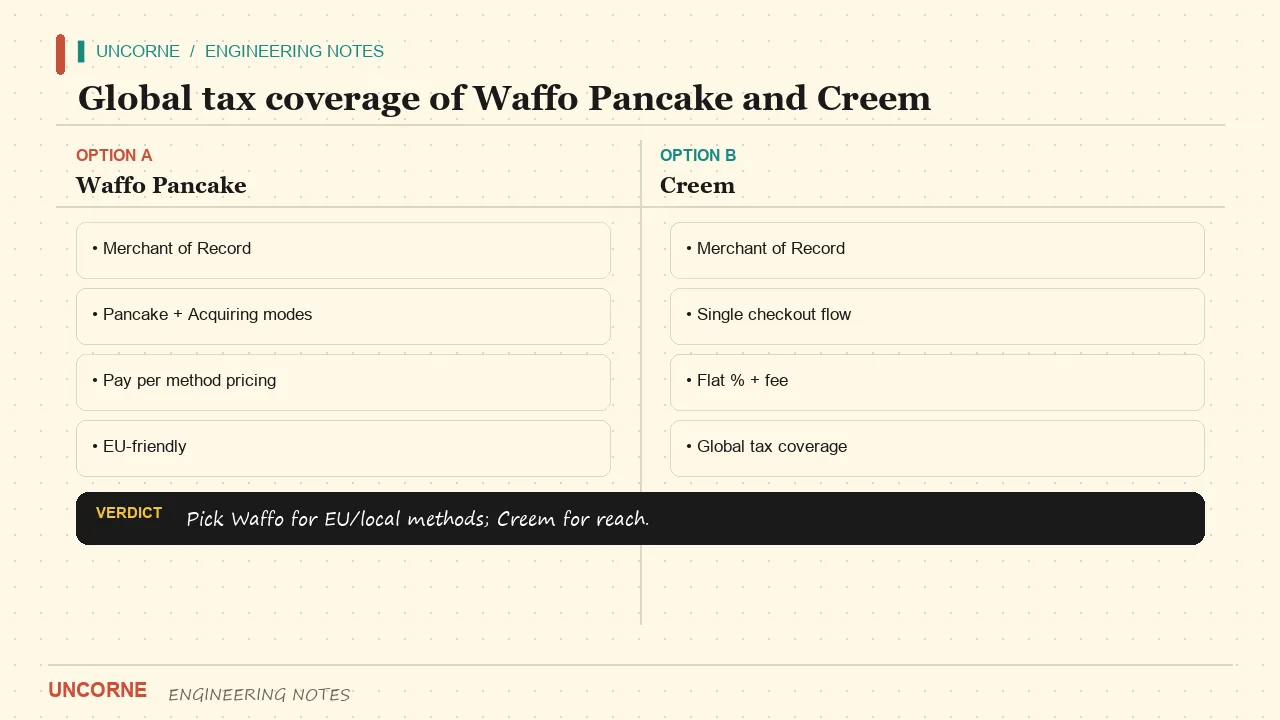
This is where a Merchant of Record earns its fee. If you sell worldwide, an MoR registers and remits VAT, GST and sales tax on your behalf. Both Waffo Pancake and Creem position themselves here; the general model is described in the Merchant of Record overview. Acquiring-only setups shift that tax burden back to you, which is fine if you already have an entity and an accountant, and a poor fit if you do not.
A practical detail: coverage is not only about countries supported, but about local payment methods. Cards dominate some markets; others prefer wallets or bank transfers. Check the methods your target customers actually use, not just the logo row on a pricing page.
Webhooks and developer experience
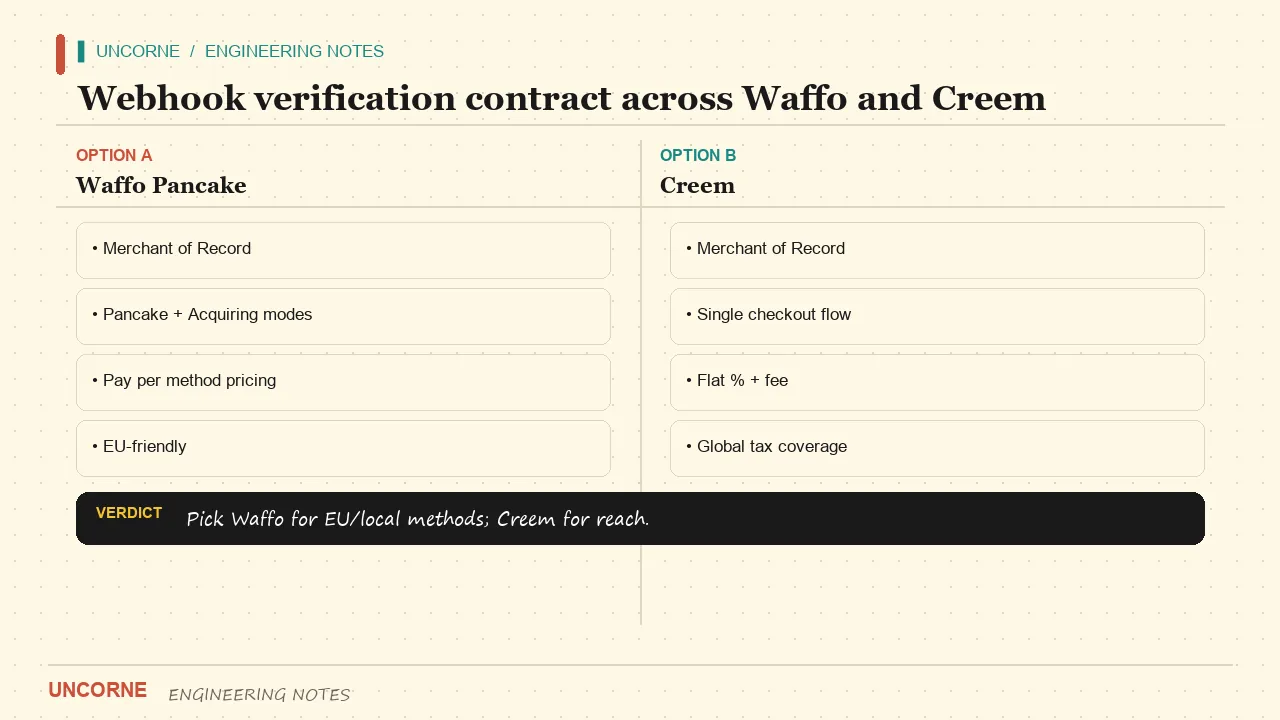
Both expose a hosted checkout, so you never touch raw card data. Creem's API is the more familiar surface if your team has used Stripe. Waffo Pancake uses a Store-Slug or API-Key authentication and a checkout-session endpoint; Waffo Acquiring signs requests with RSA and needs the platform public key for webhook verification, as detailed in the Waffo documentation. Creem's webhook documentation covers its event model.
The verification contract should not change between them:
missing or invalid signature -> throw, route returns 400
validly signed, unhandled event -> empty list, route returns 200 (ignored)
already-seen event id -> skip before writing a plan or license
If your stack already has a unified checkout plus webhook contract — as Uncorne does with its provider adapters behind one interface — the per-gateway differences stay contained to one adapter. That is the single most useful architectural decision you can make here, because it turns a hard-to-reverse choice into a manageable one. See our five-gateway comparison for how the same contract spans Stripe, PayPal and Lemon Squeezy too.
Three mistakes founders make in this comparison
- Comparing fee percentages without tax context. A raw processor's lower rate excludes VAT handling, invoicing and refund administration — work you then do yourself. Normalise for who carries compliance before comparing numbers.
- Ignoring the payout currency. If your MoR settles in a different currency than your bank account, conversion spreads eat the fee difference you just optimised.
- Treating SDK familiarity as a moat. A Stripe-like API is comfortable, but it should not decide a multi-year vendor relationship. The interface you own is your own code, not the provider's SDK.
Switching later: design for reversibility
The reason this decision feels heavy is that most people couple three things: the checkout, the webhook handler and the tax records. Decouple them. Keep checkout behind one interface, keep entitlement writes behind one verified webhook route, and keep your own plan table as the source of truth. When a provider changes its fees or its onboarding rules, you replace one adapter — not your billing model.
A concrete sign of good design: adding a sixth gateway should not require touching application code, only implementing the same interface and adding configuration. If that sounds unlike your current setup, fix it before choosing between Waffo and Creem.
What changes as you grow
At the first hundred customers, onboarding speed and API familiarity dominate. At the first thousand, different questions appear. Does the provider support the currencies your buyers now ask for? Can you issue prorated credits without a support ticket? How quickly does a dispute land in your dashboard, and can you export the records your accountant needs?
Volume also changes the fee maths. A small percentage difference becomes meaningful once monthly processed amounts reach five figures, but so do payout frequency and chargeback handling. Re-run the fee comparison with your actual numbers every quarter rather than trusting the launch-day estimate.
Finally, consider concentration risk. If one gateway processes nearly all your revenue, an onboarding review or policy change becomes an existential event. Keeping a second adapter configured and tested — even if it carries little volume — is cheap insurance.
Which to pick
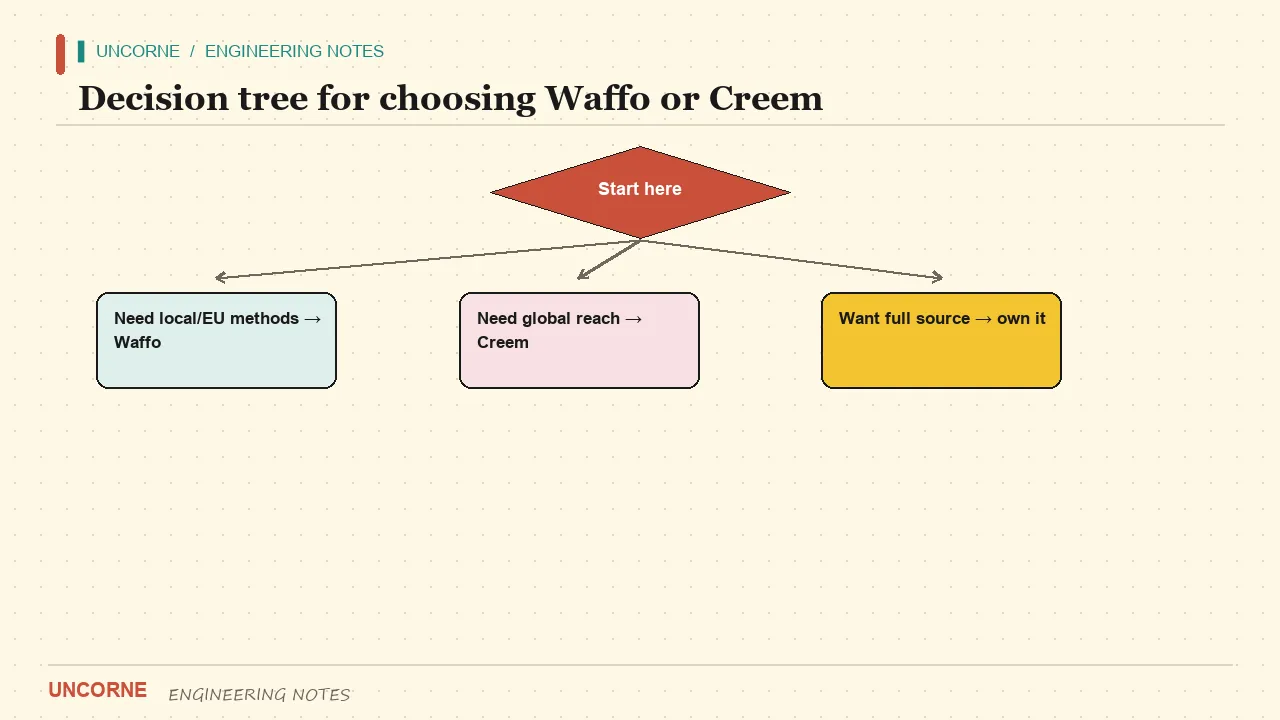
- Pick Creem if you want the fastest Stripe-like integration, a hosted dashboard and a familiar API for a digital product.
- Pick Waffo Pancake if you want a Merchant of Record with a simple global checkout and you have no company entity.
- Pick Waffo Acquiring only if you already have a regional acquiring contract in Southeast Asia and need RSA-signed flows.
- Pick neither permanently if you are unsure — build behind a switchable layer and decide after your first hundred customers tell you where they actually pay.
Honest limits
No comparison can fix fees, review times or local payment coverage for you — all three change. Treat this as a decision framework, then verify on each provider's own documentation and pricing page on the day you commit. If an article gives you a precise fee number without a date, distrust it.
The durable advice is architectural, not numerical: put one checkout contract and one webhook contract between your product and whichever gateway you choose. That makes the Waffo-versus-Creem question a configuration decision rather than a rewrite decision.
About the author: WangNan writes about shipping source-available SaaS at https://www.uncorne.com.
FAQ
Is Waffo or Creem cheaper for a SaaS?+
Both are merchant-of-record style and take a higher cut than a raw processor because they handle sales tax and compliance. Fees change often, so verify on each provider's pricing page rather than trusting a comparison snapshot. Compare payout schedule and settlement currency too.
Can I switch gateways later?+
Yes, if your checkout and webhook logic sit behind one unified interface — switching is then a configuration change. If you hard-coded one provider, it is a rewrite. Prefer the switchable layer before you pick either Waffo or Creem.
Does Waffo handle VAT like Creem?+
Waffo Pancake and Creem both act as Merchant of Record and remit tax for you. Waffo Acquiring is a regional acquiring gateway and shifts tax compliance back to the merchant. The three are not interchangeable.
Do I need a company entity to use either provider?+
Not with a Merchant of Record: Waffo Pancake or Creem becomes the legal seller and handles tax, which suits solo founders selling globally. With Waffo Acquiring or a plain processor you own tax, invoicing and compliance yourself.
All frequently asked questions · Markdown version (for AI agents)