AI SaaS Boilerplate Checklist 2026: 12 Verifiable Items

An AI-first starter in 2026 is a mature category with published buyer checklists. That is good news: you can evaluate one in an afternoon instead of trusting a landing page. Below are twelve items, each paired with a command you can actually run. None of them need access to the vendor's private repo — only the downloaded ZIP, a terminal and a little patience.
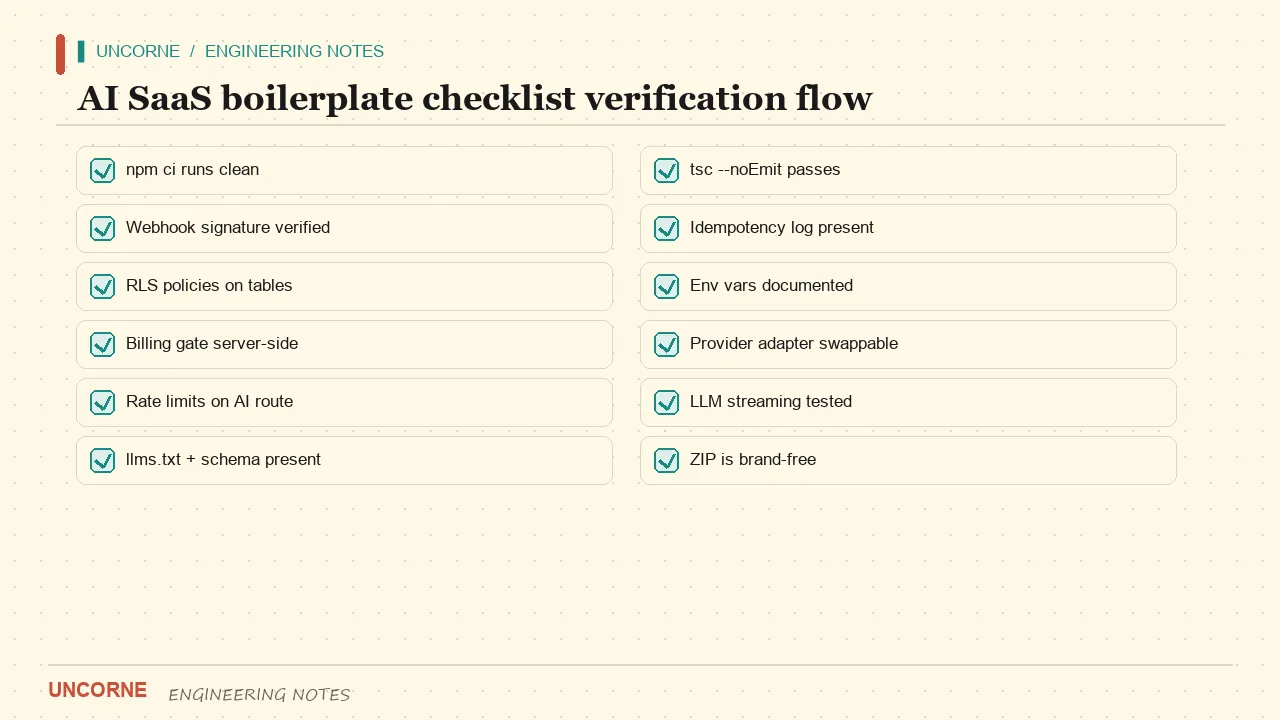
Capability baseline: expect all six
These six belong in every serious AI SaaS boilerplate in 2026. They are table stakes, not differentiators. If one is missing, keep looking.
1. Streaming output
A streaming endpoint emits text incrementally, as the model produces it. A fake one returns a single JSON blob after the model finishes and animates a typing cursor in the UI.
curl -N -s http://localhost:3000/api/chat -H 'Content-Type: application/json' -d '{"messages":[{"role":"user","content":"Count from 1 to 20"}]}'Watch the terminal: real chunks arrive before the final token. If the whole answer lands at once, the feature is theater. A network-panel screenshot showing Transfer-Encoding: chunked and several small responses is equally good evidence.
2. Multiple model providers
A serious starter keeps model access behind one route and swaps providers with an environment key. You should be able to move from OpenAI to Anthropic without touching application code.
grep -R "OPENAI_API_KEY|ANTHROPIC_API_KEY" -n lib app | head -20Then set a different key, restart and replay the same request. If the route breaks or a second vendor SDK is hard-wired into a component, the "multi-provider" claim lives only in the README.
3. Usage metering and quotas
Usage must be counted server-side and enforced before the provider call, not displayed as a decorative number in the dashboard.
for i in $(seq 1 25); do curl -s -o /dev/null -w "%{http_code} " http://localhost:3000/api/chat -d '{"q":"hi"}'; done; echo
curl -s -D - http://localhost:3000/api/chat -d '{"q":"hi"}' | grep -i "retry-after|ratelimit"
You want a 429 once the quota is exhausted and a truthful Retry-After header in the response. A UI that merely hides the button is not a quota.
4. Retrieval with citations
Retrieval means the answer can be traced back to a chunk of your own document. Ingest a test PDF and ask a question only it can answer.
curl -s -X POST http://localhost:3000/api/ingest -F '[email protected]'
curl -s http://localhost:3000/api/ask -H 'Content-Type: application/json' -d '{"q":"What is the refund window?"}' | jq '.sources'
The sources array must contain document names and chunk ids (or page numbers), and those markers should also appear inline in the rendered answer. A confident paragraph with no provenance is a hallucination you cannot audit.
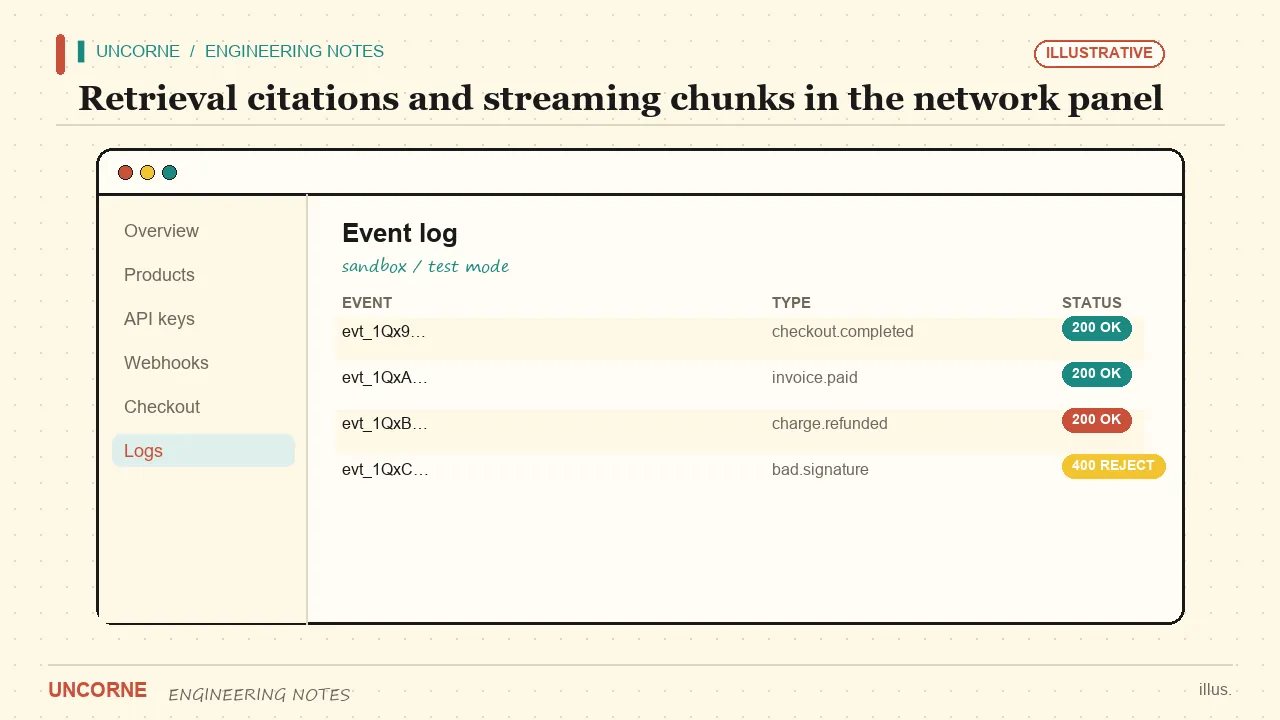
Production baseline: the items vendors skip
5. Tool calling and MCP
An agent client must be able to discover and call your tool endpoint without a custom integration. The Model Context Protocol specification is the reference contract here.
npx @modelcontextprotocol/inspector http://localhost:3000/mcpThe inspector should list your tools with typed inputs. If discovery only works inside the vendor's own demo chat, you have a private SDK, not MCP.
6. Provider error honesty
Inject an invalid key and confirm the failure is real and logged.
OPENAI_API_KEY=sk-invalid npm run devIn a second terminal, call the chat route, then read the server log. You want a 5xx (or a clean 4xx with a real message) and a structured server-side error entry. A cheerful, generated answer during an auth failure means errors are being swallowed.
7. Webhook signature verification
Billing webhooks are the most forged requests your app will ever receive. The Stripe signature guide spells out the expected check.
curl -s -i -X POST http://localhost:3000/api/webhooks/stripe -H 'Content-Type: application/json' -d '{}'An unsigned body must return 400, never 200. Also replay a body with a stale timestamp — that should fail too.
8. Idempotency
Providers retry. The same event id delivered three times must produce one write.
psql "$DATABASE_URL" -c "select event_id, count(*) from processed_events group by 1 order by 2 desc limit 5;"Replay one captured event three times with a valid signature (see the event types reference), then rerun that query. Any event_id with a count above 1 is a duplicate-write bug.
9. Guardrails and rate limits
Rejections must happen on the server before an expensive model call.
curl -s -o /dev/null -w "%{http_code}
" -X POST http://localhost:3000/api/chat -d '{"q":"hi"}'
Unauthenticated should be 401 and over-quota 429. If the endpoint returns 200 and the UI simply hides the input, the guardrail is cosmetic.
10. Observability
curl -s http://localhost:3000/api/health | jq .
grep -R "error_events" -n lib | head
/api/health should probe the database, not just return { "ok": true }. Look for structured logs, an error boundary and a local error_events table with an optional ERROR_REPORT_URL sink. Then ask who configures that sink and who gets paged — code cannot page anyone by itself.
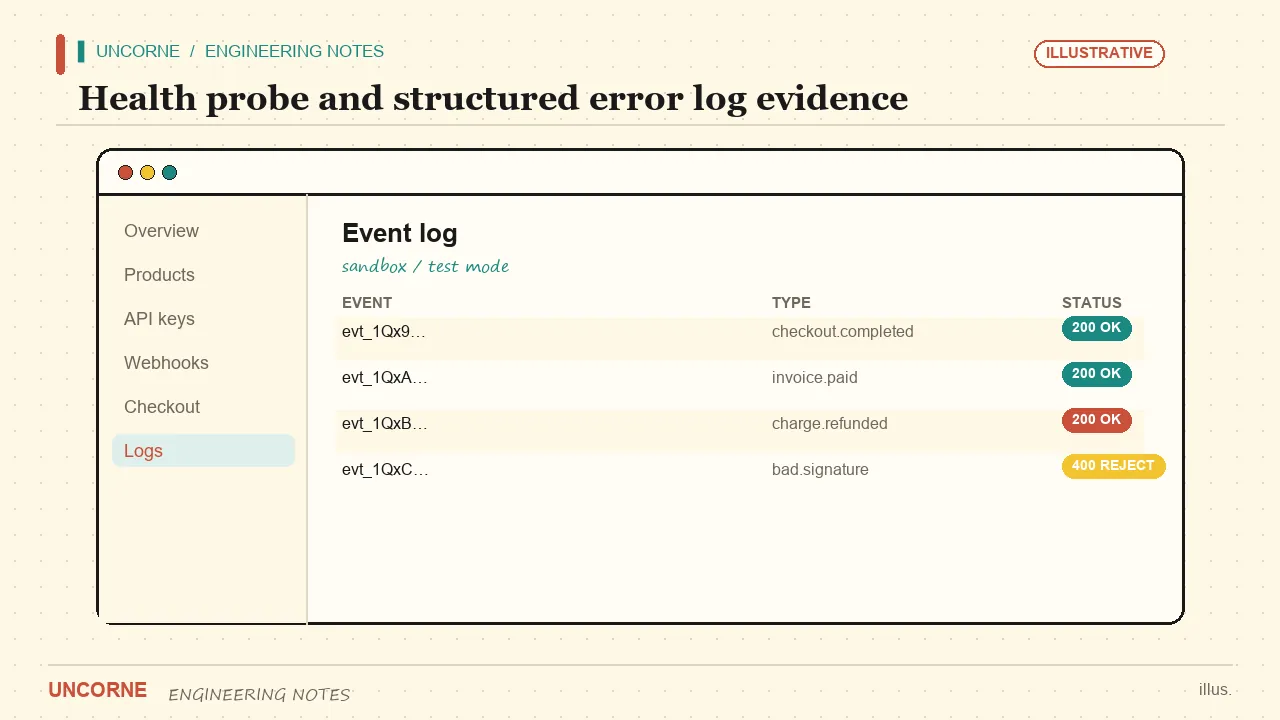
11. Agent-readable docs
for f in AGENTS.md llms.txt openapi.json; do test -f "$f" && echo "OK $f" || echo "MISSING $f"; doneThe llms.txt proposal and the OpenAPI 3.1 spec are the two contracts worth requiring. Check that these files are inside the ZIP, not just on the marketing site, and that style rules are scoped so an agent cannot rewrite your design system.
12. Cost visibility
psql "$DATABASE_URL" -c "select user_id, sum(prompt_tokens) as prompt, sum(completion_tokens) as completion from usage group by 1 order by prompt desc limit 10;"If token counts are missing, you cannot connect a quota to a bill. Even without a cost dashboard, raw counts let you compute spend and spot abuse.
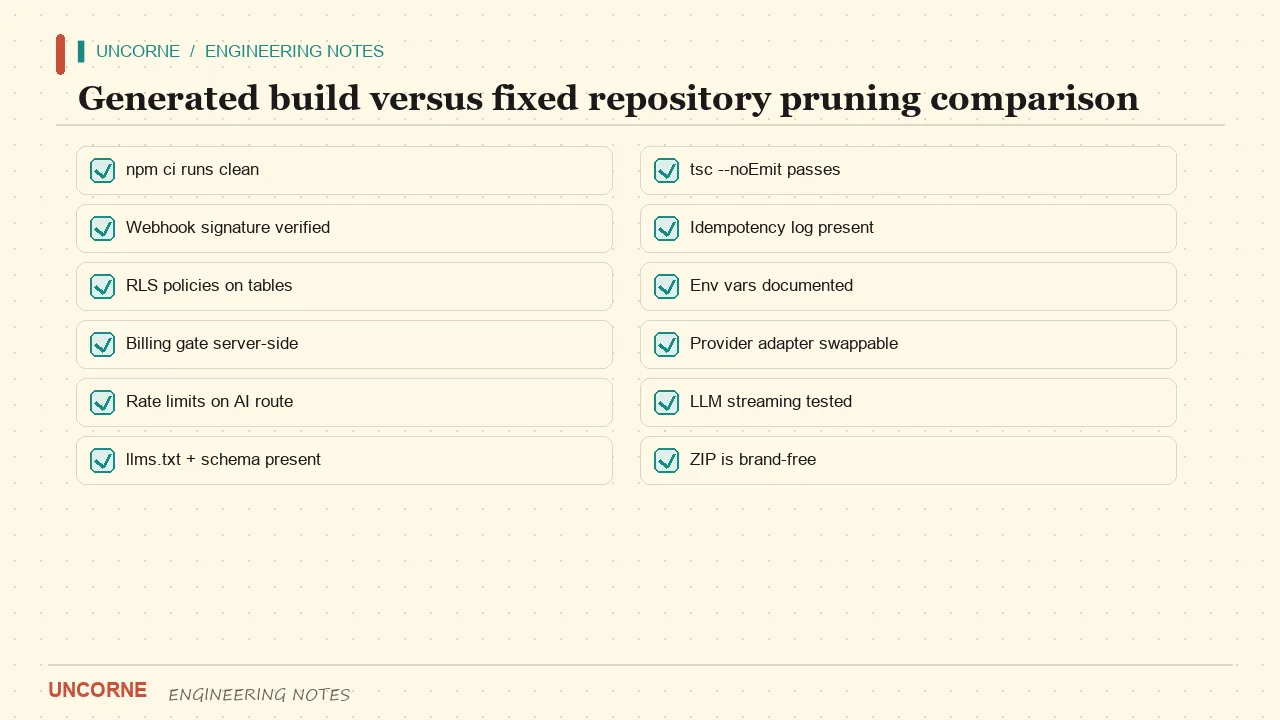
What is not on this checklist
Brand name, hero animation and the number of demo screens. Also not: vendor self-reports like "save 480 hours" — those are not verifiable. Do not treat any single baseline item as a differentiator; by late 2026 they are the entry ticket. A long feature table is easier to write than a verifiable checklist, which is exactly why you should prefer the latter.
The one question that still separates products
Ask: do I receive the same fixed repository as everyone else, or a build generated from my own configuration with unselected modules actually removed? Uncorne takes the second path — the Builder selects auth, gateway, AI providers, features and style, and the server returns only those modules. If a vendor answers "a fixed repo", budget time to delete code you did not ask for and to check that deleting it leaves no dead links. A checklist tells you what to verify; a generated build removes most of what needed verifying.
FAQ
Is MCP support a differentiator in 2026?+
No. MCP endpoints, tool calling, usage billing, evals and observability now appear in public buyer checklists for AI agent SaaS boilerplates. Treat them as baseline and verify them with the inspector command rather than paying a premium for the claim.
How do I verify a vendor's streaming claim?+
Open the network panel or curl the endpoint with -N and watch whether chunks arrive before the model finishes. A single JSON response at the end is not streaming, even if the UI animates a typing indicator.
What is the most common hidden gap in AI starters?+
Webhook signature verification and idempotency on the billing path, plus honest provider error propagation on the AI path. Both look fine in a demo and fail on the first forged request or invalid API key.
Does a fixed starter repository save time?+
Only at the start. A fixed repo arrives complete, but you still delete unselected modules and hunt for dead links. A generated build from your own configuration removes them before delivery — verify by grepping the ZIP for routes you never selected.
All frequently asked questions · Markdown version (for AI agents)