AI SaaS Boilerplate Comparison 2026: Honest Review

If you searched for a ShipFast alternative or a Makerkit alternative, you are weighing the same four or five names everyone recommends. But a feature checklist will not settle it — by 2026 most of those checkboxes are identical. The useful question is where the products stop being comparable: what they actually give you, how they deliver it, and what is still honest scaffolding. This comparison is written by the team behind Uncorne, so we will name our own limits as carefully as everyone else's.
What counts as baseline in 2026
By late 2026, a serious AI-first starter includes streaming LLM responses, more than one model provider, token or credit metering, retrieval-augmented generation, an MCP endpoint, agent instructions in AGENTS.md and an llms.txt discovery file. These are table stakes, not differentiators. The Model Context Protocol documentation standardises how tools and data sources are exposed to agents; llms.txt is a small convention for telling crawlers which documentation matters. Both are cheap to add and increasingly expected.
On the storage side, vector search and embeddings are well-trodden: the Supabase AI guide and the OpenAI embeddings guide describe the same pattern you will find in several kits. If a vendor markets any one of these as a breakthrough, ask what happens when you swap the model provider — that is usually where the claim thins out.
Public buyer checklists now include evals, queues, observability and guardrails next to the older auth-and-billing list. Useful, yes. Unique, no. Treat them as a hygiene test: a kit missing all of them is behind; a kit with all of them is merely current. Discoverability belongs in that list too — Google's structured data guidance is a few lines of markup, and answer engines quote what you make easy to parse.
The shortlist, with primary sources
We checked each product against its own site rather than an affiliate roundup. Prices below are vendor list prices last verified 2026-09-14; promotions rotate, so re-check before you buy.
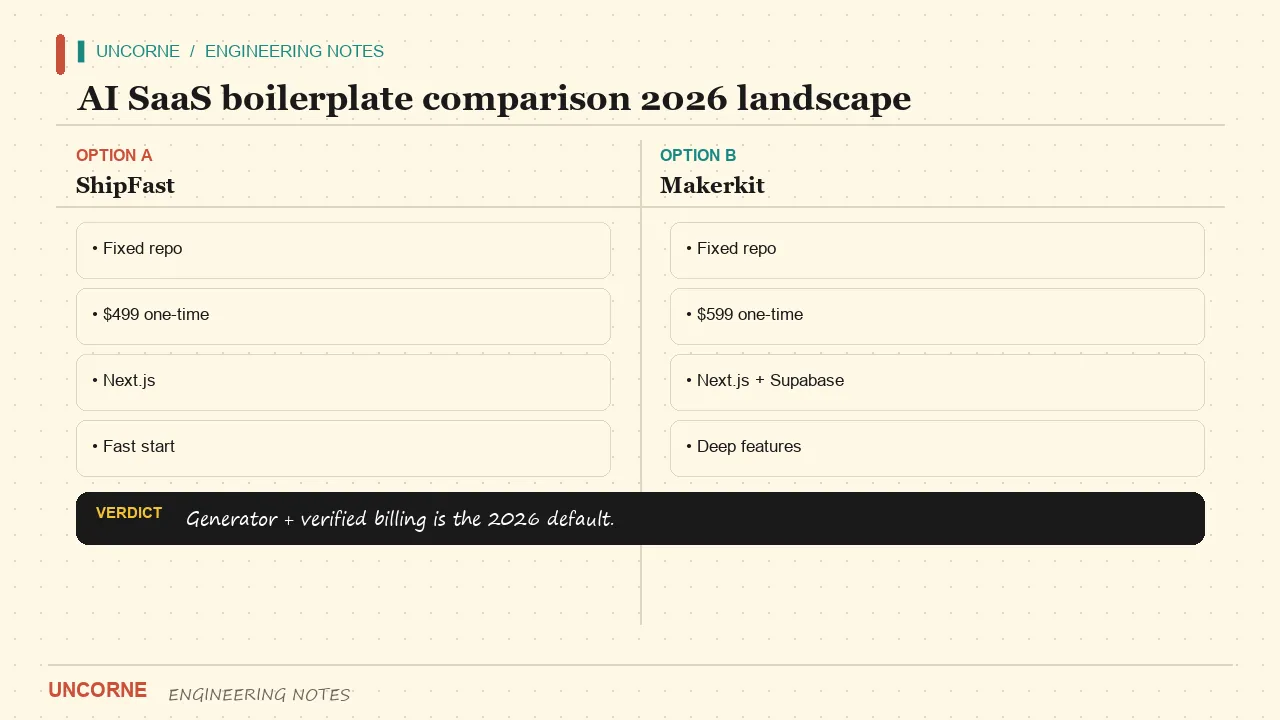
ShipFast
ShipFast is the lean, strongly opinionated pick. It is built to get a landing page and a Stripe or Lemon Squeezy checkout up in an afternoon, with auth, email and SEO already wired. The surface is deliberately small and the documentation is tutorial-shaped. This is the right choice when you plan to diverge hard from the starter — you will be deleting less. The trade-off is that org structures, roles and multi-tenancy are not first-class; you add them yourself.
MakerKit
MakerKit is the batteries-included, enterprise-leaning option. It ships organisations, roles and real team management from day one, with strong Supabase alignment. If your product is B2B and you expect customers to invite colleagues in week one, the structure is already there. The cost is surface area: more concepts to learn, more files to understand before you change one. Teams pay for that structure; solo founders often find they are carrying code they never use.
Supastarter
Supastarter is Supabase-native and unusually explicit about choice: multiple auth methods, organizations that can be switched off from config, Prisma or Drizzle, Hono for the API, i18n, and an AI integration built on the Vercel AI SDK. Its own documentation mentions AGENTS.md and a structured codebase for AI agents. If your entire stack is Supabase, the fit is excellent. If you later swap the backend, that same alignment becomes friction.
The AI-first kits in the \$179–\$249 band
A cluster of kits sell streaming chat, credit billing, RAG and agent documentation as a fixed GitHub repository with a one-time licence. They are a reasonable middle ground: more AI surface than ShipFast, less enterprise structure than MakerKit. Check two things: whether the AI provider layer is swappable, and whether usage metering writes to a table you own rather than a vendor dashboard you cannot export.
Uncorne: a generator, not a fixed repository
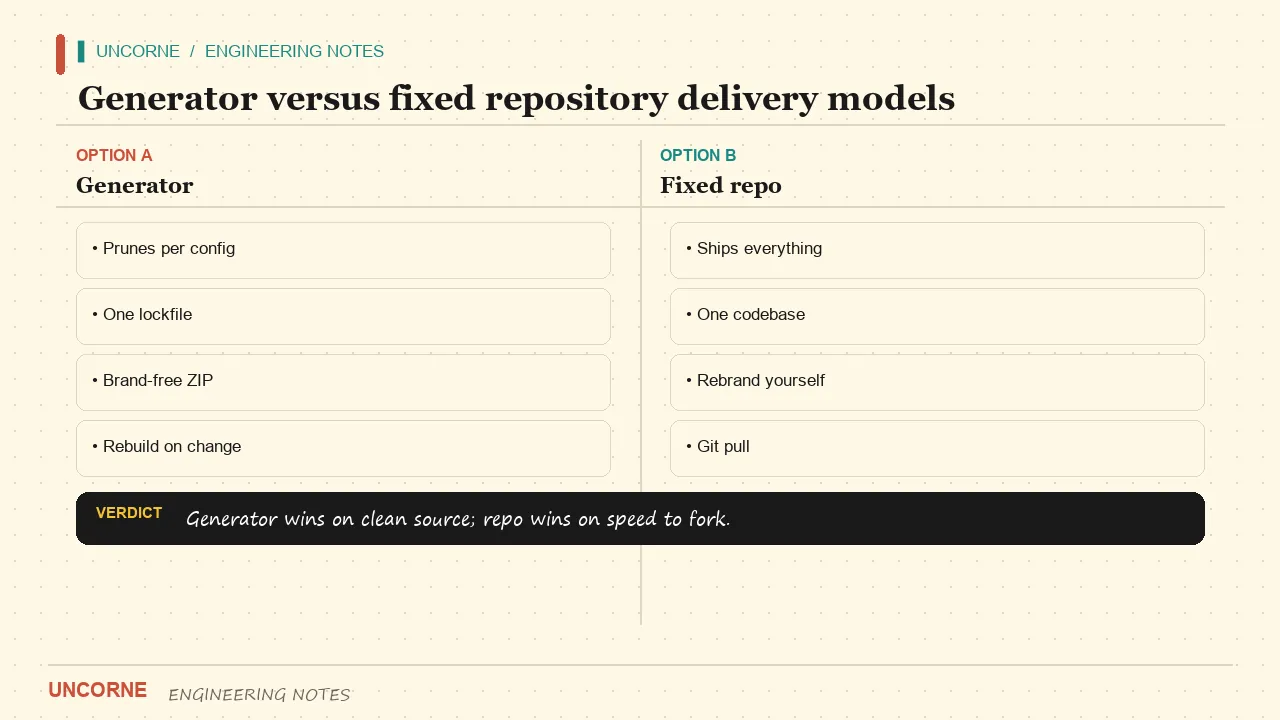
Uncorne is the odd one out. You pick auth, gateway, AI providers, features, deploy target and visual style in a configurator, and the server returns a pruned, brand-free ZIP. You get only the modules you selected; unselected code is genuinely removed and navigation is rewritten so no dead links remain. The differentiator is delivery infrastructure, not one more AI feature. We will be precise about what that means below.
Which to pick: a decision table
| If your priority is… | Pick | Why | | --- | --- | --- | | First paying customer this week, minimal surface | ShipFast | Smallest codebase, fastest landing page | | B2B teams, orgs and roles from day one | MakerKit | Organisation and RBAC are first-class | | All-in on Supabase, want config-level flexibility | Supastarter | Supabase-native, switchable modules | | AI features now, fixed repo, mid-range budget | AI-first kit | Streaming and credit billing included | | A productised, brand-free source deliverable | Uncorne | Pruned ZIP per configuration | | Unsure — want to compare on honest limits | Any, then read their limits page | No starter is universally best |
A concrete recommendation: if you are a solo founder shipping a single product, ShipFast gets you to revenue fastest and you can add structure later. If you already know you are selling to teams, start with MakerKit or Supastarter — retrofitting organisations is more expensive than deleting them. Choose Uncorne when the way the code is delivered matters: a clean, brand-neutral tree with exactly the modules you paid for, and an entitlement layer you can resell or white-label.
Price is not the whole story
List prices are easy to compare and mostly irrelevant on their own. A \$0 MIT starter can cost more than a \$299 kit if you spend a week wiring email, teams and webhooks. Conversely, a \$649 Teams licence is cheaper than rebuilding organisations yourself — but only if you actually ship those features. Hosted databases, email overages, processing fees and your own time are the real line items. The table above gives sticker prices because those are verifiable; the decision should use total cost to first customer.
If you plan to expose an API that agents call, check whether the kit emits an OpenAPI 3.1 description. Hand-written API docs age badly; a generated contract is the difference between an agent that integrates in an afternoon and one that stalls on guesswork.
The delivery layer nobody else needs
Because the download IS the product, Uncorne has to solve problems a fixed starter never faces. A licence key or subscription gate must fail closed in production. An anonymous preview must show a skeleton only, signed with a short-lived visitor token, so nobody can reconstruct the source from a demo. Five payment providers share one verification contract. Copy exists in five languages. The Supabase/SQLite switch is driven entirely by environment variables. And a CI matrix downloads and type-checks every representative build.
// shipkit.config.json — the selection that determines the ZIP
{
  "auth": "supabase",
  "gateway": "waffo",
  "ai": ["openai", "anthropic"],
  "features": ["chat", "rag", "usage-metering"],
  "deploy": "vercel",
  "style": "editorial"
}
None of that is an AI capability. It is what makes selling configurable source code possible — and it is why we are careful about claims. Emitting FAQPage structured data is easy; building a licence gate that fails closed is not. And when you sell globally, the Merchant of Record question matters more than any feature badge.
Two baseline items demos rarely show
Background jobs — a queue for emails, usage rollups and webhook retries — separate a starter that works for ten users from one that works for ten thousand. Ask to see the queue, not the diagram. Evals are the other: a repeatable way to check that a prompt change did not make your assistant worse. A kit that ships an eval harness quietly saves you the week you would otherwise spend building one.
The questions to ask before you buy
Marketing pages converge; the answers to these questions do not. Ask each vendor to show you, not tell you:
- The webhook log from a failed payment, including the retry. If there is no log, there is probably no idempotency layer.
- The exact command that removes one module and leaves no dead imports. A real generator has one; a template with an
rm -rfnote in the docs does not. - Where usage metering writes. If the answer is "our dashboard", ask for an export path before you build on it.
- The licence file in the delivered ZIP. MIT is fine; a custom licence that limits resale is not the same product.
- What happens if the vendor disappears. Source you can compile without their service is the only durable answer.
None of these questions are rude. Vendors who built the thing you are asking about answer in minutes. Vendors who have not talk about the roadmap.
Migration cost is the other hidden line. The cheapest starter to leave is the one you chose for the right reason. Pick ShipFast and later need organisations, you will write them. Pick MakerKit and ship a single-user tool, you will carry unused structure through every deploy. Pick a Supabase-native kit and later move to another Postgres host, you will rewrite the data layer. None are disasters; all are predictable. Ask before buying: which part of this starter will I definitely delete, and which part will I definitely write? The answer should be specific enough to put in a ticket.
A CI matrix that downloads eighteen representative combinations and type-checks each one is not a stunt — a generator that prunes modules has to prove every combination still compiles. If a starter cannot show you something similar, treat "configurable" as a claim in a markdown file.
Honest limits
Uncorne is a honestly bounded starter, not a complete platform. The consoles do have profile and role mutation endpoints and a billing portal, but the local auth path has no MFA, OAuth or session rotation. SMTP is deliberately not implemented — you use the Resend, SendGrid, Postmark or Mailgun REST APIs, a custom HTTP mailer, or a safe no-op. The mail retry queue and an optional external error sink exist but require an operator-configured cron and ERROR_REPORT_URL. Download and redemption events are logged with hashed emails, and the refund rule remains a plain 14-day window. Multi-tenancy ships SQL and helpers, but you must scope your own domain tables.
In plain terms: if you need a batteries-included B2B tenant model on day one, MakerKit or Supastarter go deeper. If you need SMTP baked in, the generator's paths will not do it for you. We would rather say that in a comparison than discover it in your first support ticket.
How we verified this comparison
We read each vendor's own product page rather than affiliate roundups. The price points quoted above were last checked 2026-09-14 and are list prices before promotions. ShipFast, MakerKit and Supastarter all publish pricing on their own sites, so you can verify the numbers yourself. Claims about streaming, MCP or agent support were taken from those same pages, not from third-party summaries. Where a kit is vague about a capability, we say so instead of guessing.
Final verdict
No starter is universally best. Choose against the 40% that is yours: the part of the product a competitor cannot copy. Everything else is a cost you pay once and then forget. For the detailed checklist behind this comparison, read AI SaaS Boilerplate Checklist 2026 and Agent-Ready SaaS Docs. For billing specifics, Next.js Subscription Billing covers the webhook contract in full.
FAQ
Is streaming AI output a differentiator in 2026?+
No. Streaming, multi-provider chat, token metering, RAG, MCP, AGENTS.md and llms.txt are baseline across paid AI starters and many free ones. Compare on delivery model, honest limits, and what you actually have to write yourself.
Which boilerplate should I pick for a B2B product with teams?+
MakerKit and Supastarter go deeper on organisations, roles and multi-tenancy from day one. Retrofitting organisations into a lean single-user starter is usually more expensive than deleting structure you do not need. Read each vendor's own limits page before deciding.
What does a generator do that a fixed repository cannot?+
It removes unselected modules from the downloaded source instead of leaving dead code, rewrites navigation so no dead links remain, and produces a brand-free ZIP per configuration. A fixed repository gives every customer the same tree.
Is Uncorne open source?+
The site and its documentation are public; the generated template is a paid, licensed product delivered as source. Each ZIP ships an MIT LICENSE file and the customer may rename and restyle it. The generator and marketing pages are stripped from the delivered code.
How did you verify the comparison and the prices?+
We read each vendor's own product and pricing page rather than affiliate roundups, and last checked list prices on 2026-09-14. Primary sources are linked inline: shipfa.st, makerkit.dev and supastarter.dev. Promotions rotate, so re-check the live price before buying.
All frequently asked questions · Markdown version (for AI agents)