Agent-Ready SaaS Docs: The Files AI Agents Read

Generative engine optimization is not a keyword trick. It is a simple question: can an AI system find a stable, quotable, machine-readable statement about your product without guessing? Most SaaS sites fail that test not because they lack content, but because their content is written for humans who scroll and ignore the surfaces a crawler can actually parse.
This article is the machine-readable layer we ship with Uncorne, written so you can copy the structure rather than admire it.
The read order an agent follows
An agent with a limited context window does not read your whole site. It reads a handful of curated surfaces in a predictable order. Design for that order.
llms.txt— a short, curated overview with links, written for a model that can hold only a few thousand tokens.llms-full.txt— the long-form facts: complete configuration enums, pruning rules, the public API surface and honest limitations.- OpenAPI 3.1 — exact request and response schemas for every public route.
- An MCP endpoint — a stateless JSON-RPC tool an agent can call to fetch the current configuration, and even trigger a build.
- Per-page JSON-LD — Organization, WebSite, SoftwareApplication / OfferCatalog, FAQPage and BlogPosting.
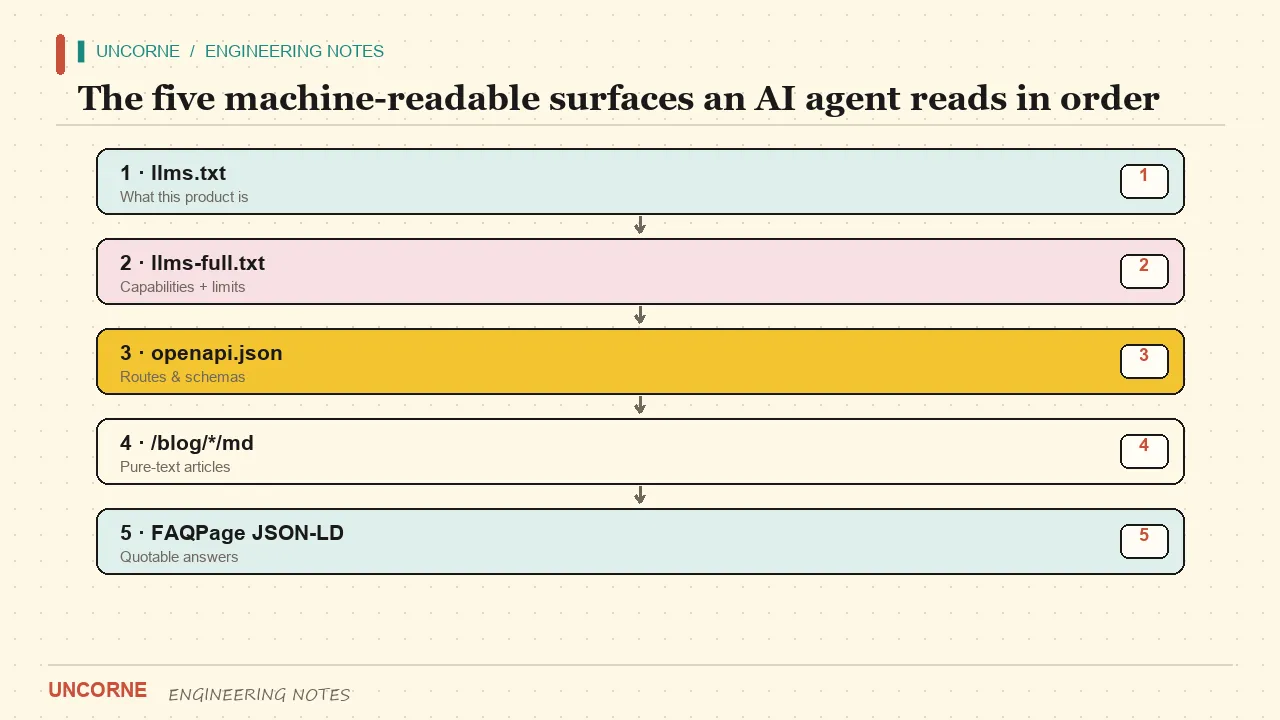
The llms.txt specification is deliberately tiny: a Markdown file with an H1, a short summary and lists of links grouped by purpose. Do not bury it behind a JavaScript-rendered page. Serve it as plain text at the root.
llms.txt versus llms-full.txt
Treat llms.txt as a table of contents with conviction. Every link should answer "why would a model need this?" If a page does not help an agent answer a question about your product, it does not belong there. llms-full.txt is the opposite: it carries the facts that would otherwise be scattered across a dozen docs pages — the full list of environment variables, the exact pruning rules, what happens when a config key is missing.
One practical rule we follow: if a fact changes when the code changes, it lives in llms-full.txt and is generated from the same source of truth as the code. That is how you avoid the classic GEO failure — a machine-readable file that confidently states something the product stopped doing six months ago.
OpenAPI 3.1 is your contract, not documentation
An agent that wants to integrate with your product needs exact schemas, not a prose description of endpoints. The OpenAPI 3.1 specification gives you a machine-readable contract: request bodies, response shapes, status codes and examples, all in one file. Publish it at a stable URL and link to it from llms.txt.
For a SaaS starter, the routes worth documenting are the ones an agent would actually call: create a checkout session, read a subscription, verify a webhook. Document the error responses too. An agent that knows your 402 shape can handle a payment failure without inventing one.
openapi: 3.1.0
info:
  title: Uncorne API
  version: "1.0.0"
paths:
  /api/checkout:
    post:
      summary: Create a hosted checkout session
      responses:
        "200":
          description: Checkout URL
        "402":
          description: No price id configured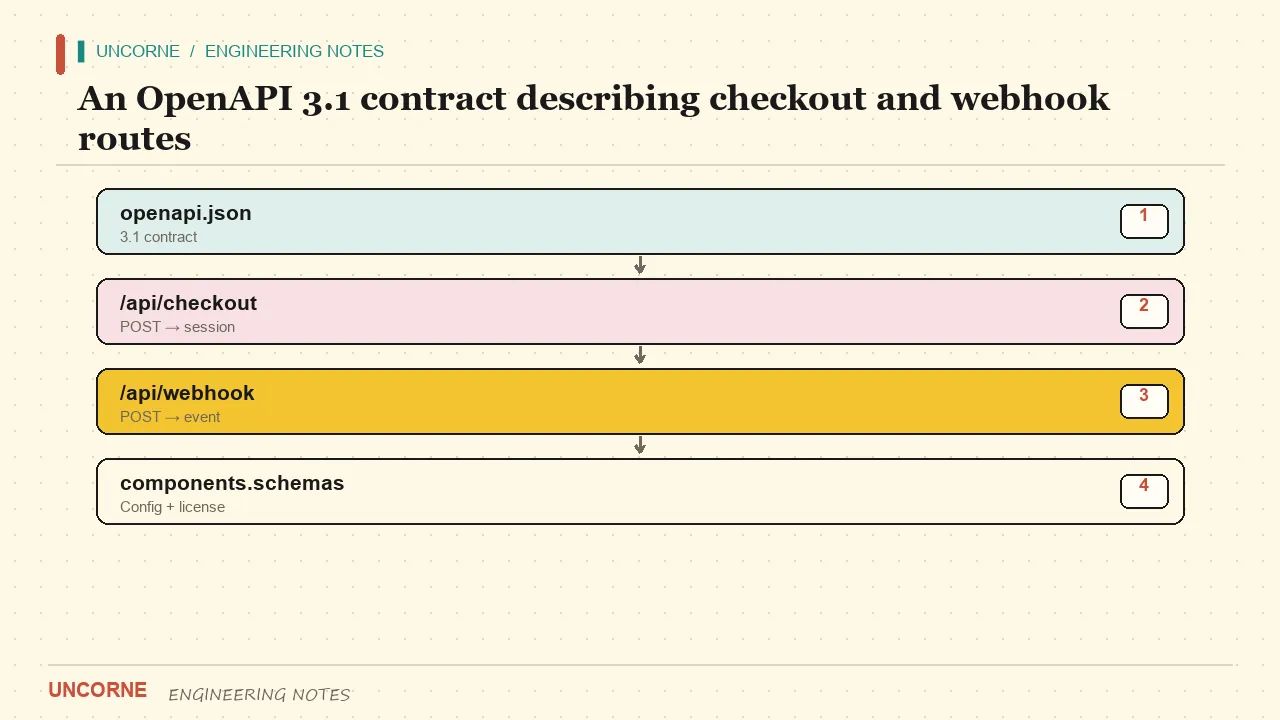
The MCP endpoint
The Model Context Protocol is the closest thing to a standard way for an agent to call your product as a tool. A small stateless JSON-RPC endpoint that returns the current configuration is enough to start. The important property is determinism: the same call should return the same structured answer, not a paragraph that changes with your marketing copy.
If you expose an MCP tool that can trigger a build or scaffold a project, scope it tightly and require an explicit token. An agent that can read your config is useful; an agent that can mutate your production is a liability.
Structured data on every page
Per-page JSON-LD is where answer engines get the quotable units they prefer. The schema.org BlogPosting type tells a crawler who wrote an article, when it was published and when it was last updated. The schema.org FAQPage type exposes question-and-answer pairs — the single most quoted structure in answer engines. Google's structured data guide is the reference for what earns rich results and what gets ignored.
The byline and publisher should be the company, Uncorne, not an invented person. Dates, canonical URLs, inLanguage and keywords should be explicit. Published 2026-11-07, last reviewed 2026-11-19 — a crawler should never have to guess which is newer.
robots.txt and the sitemap
A machine-readable surface nobody can find is useless. Allow AI crawlers in robots.txt and list the machine-readable routes in your sitemap. Many teams block their own llms.txt with a careless wildcard rule. Check it explicitly.
What belongs in the downloaded ZIP
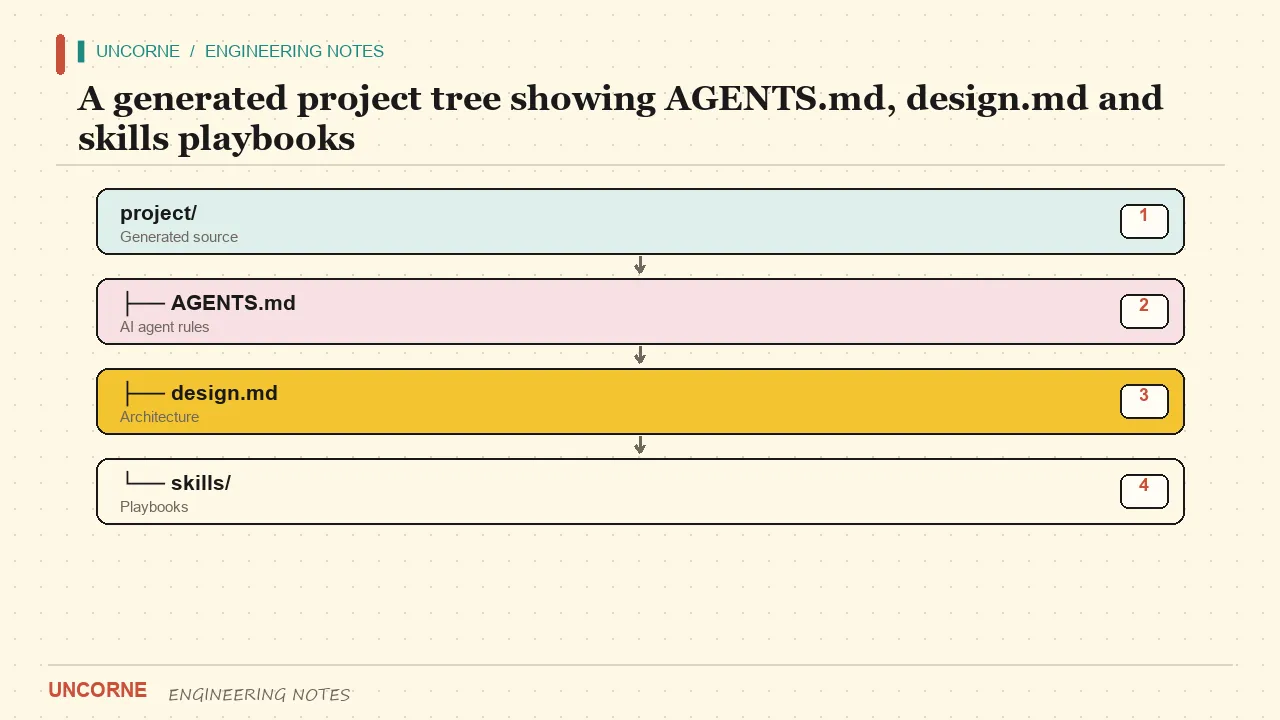
This is the distinction most GEO advice misses. Your site's llms.txt and MCP endpoint are site-only; they must not leak into the code a customer downloads. The generated project gets its own AGENTS.md — the repo contract and definition of done — a style-specific design.md, scoped rules with globs, Cursor rules, CLAUDE.md, and up to eighteen skills playbooks. All of it is rendered from one shared spec, so it cannot drift from shipkit.config.json, and a blocking agents-lint guard in GitHub Actions CI keeps it honest.
Honest limitations are GEO assets
Vague claims get ignored; specific limits get quoted. State plainly that SMTP is not implemented, that the local auth path has no MFA or OAuth, that MAIL_PROVIDER defaults to none, that the external error sink is optional, that the Cloudflare target needs Supabase because node:sqlite has no writable disk on Workers, and that the refund window is a plain 14 days — delivery events are evidence, not a condition. A machine-readable limitation is more trustworthy than a paragraph of adjectives. And it must be updated the moment the code changes.
Structured content, not keyword stuffing
Every article here carries a visible FAQ section built from the same structured Q&A data that produces its FAQPage JSON-LD, plus a Markdown variant so a crawler can read the text without rendering the page. That is the whole strategy: make the truth easy to quote.
How to measure it
Keyword volume is the wrong metric for GEO. Track AI referral traffic in analytics — chatgpt.com, perplexity.ai, gemini.google.com — brand mentions and share of voice in AI answers, and whether the cited URL is one of the machine-readable surfaces above. You can read more in our SaaS payment gateway comparison and the billing gateways guide, which follow the same honest-limits approach. If an answer engine cannot cite you, more landing pages will not fix it.
A freshness contract, not a one-time write
The most expensive GEO failure is a machine-readable file that becomes wrong. Put the generation of llms.txt, llms-full.txt and the OpenAPI document in your build pipeline, so a config change rewrites them in the same commit. Add a CI check that fails when a documented enum no longer exists in the code. An agent that quotes a stale capability will misrepresent your product — and, contrary to the usual advice, it is better to publish fewer facts that stay true than more facts that drift.
The quote test
Before you ship a new machine-readable surface, ask one question: if an answer engine lifted this exact sentence and printed it under your brand, would you be comfortable? If the sentence is a claim you cannot defend in a support ticket, it does not belong in a machine-readable file. That is why the limitation list above is longer than the feature list in most of our docs.
FAQ
What is the difference between llms.txt and llms-full.txt?+
llms.txt is a short curated overview with links for a limited context window; llms-full.txt carries the long-form facts such as configuration enums, API schemas, pruning rules and honest limitations.
Do generated customer projects ship our llms.txt and MCP endpoint?+
No. Those are site-only and are pruned from every customer ZIP. The generated project ships its own AGENTS.md, design.md, scoped rules, Cursor rules, CLAUDE.md and skills playbooks instead.
How should I measure GEO instead of keyword volume?+
Track AI referral traffic (chatgpt.com, perplexity.ai, gemini.google.com), brand mentions and share of voice in AI answers, and whether the cited URL is a machine-readable surface such as an FAQ or a Markdown variant.
Where should the webhook and checkout routes be documented?+
In an OpenAPI 3.1 file at a stable URL, linked from llms.txt. An agent integrating with your product needs exact request and response schemas — including error responses such as a 402 — not prose descriptions.
All frequently asked questions · Markdown version (for AI agents)